Fleshy nose revision rhinoplasty is the definitive solution if you are still unhappy with a wide, bulbous tip or persistent swelling a year after your primary surgery. Correcting “fleshy” noses, which are defined by thick skin and weak cartilage, is widely considered the most challenging aspect of nasal surgery. However, with the right expertise, secondary rhinoplasty can successfully correct structural defects and restore the refined look you originally desired. This guide covers everything you need to know about restoring your confidence through revision surgery.
Why is Revision Surgery for Fleshy Noses More Sensitive than Bony Noses?
Fleshy noses have two distinct characteristics: thick, oily skin and weak, thin cartilage. Revision rhinoplasty for a fleshy nose is significantly more sensitive because the nasal tissues have already been manipulated once.
In the primary surgery of a fleshy nose, if the surgeon lacked sufficient experience and merely reduced the cartilage without reinforcing the nasal skeleton, the thick skin would have no structural support to rest upon. Over time, this causes the nose to droop or take on a shapeless, “ball-like” form.
In revision surgery for fleshy noses, the procedure is far more difficult due to the following reasons:
- Scar Tissue (Fibrosis): The thick skin of a fleshy nose often develops severe fibrosis and adhesions after the first surgery. Separating this skin from the skeleton without damaging the blood supply requires an extremely high level of skill.
- Depleted Cartilage Bank: Usually, in the first surgery, the septal cartilage (the wall between the nostrils) has already been removed. To repair and reshape the tip of a fleshy nose, the surgeon needs building materials, which must often be harvested from the ear or rib.
Dr. Armin Akbari, with a precise understanding of these challenges, focuses on “Structural Reinforcement.” This ensures the nose can support the weight of the thick skin and achieve a refined, compact shape.
Main Goals of Fleshy Nose Revision Surgery
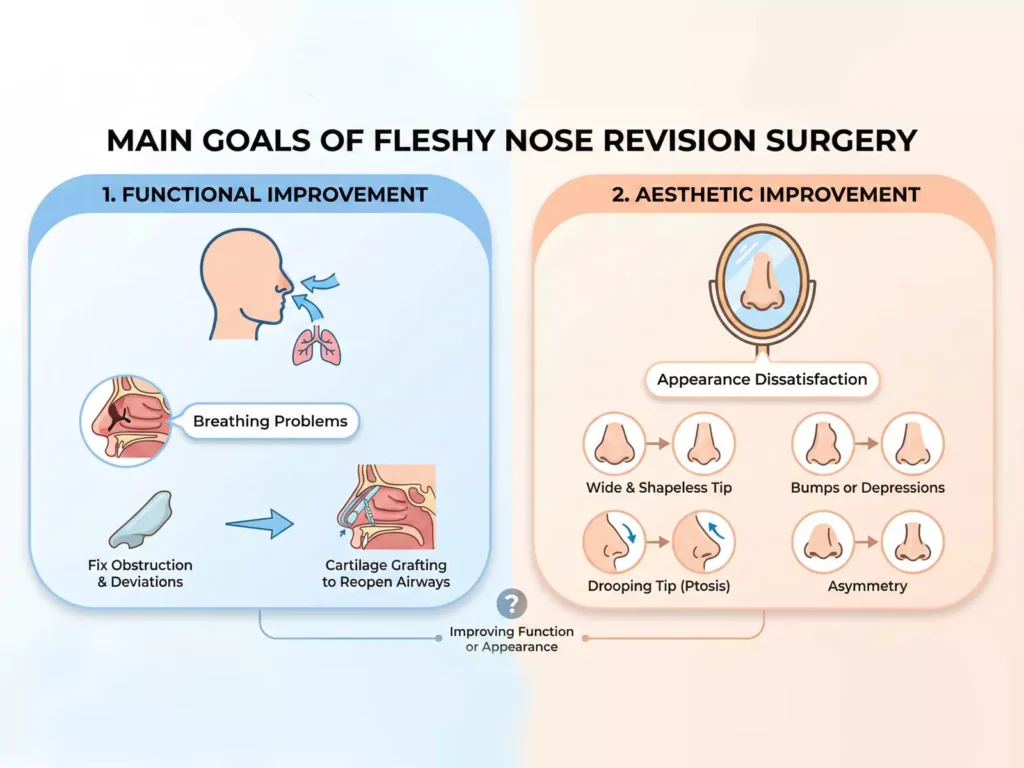
Since corrective rhinoplasty involves greater challenges and sensitivities, it is generally performed to improve either the function or the appearance of the nose. Patients typically seek revision for two main reasons:
۱. Structural Correction and Functional Improvement (Breathing Problems)
If the patient experiences breathing difficulties after the primary rhinoplasty due to nasal airway obstruction or similar issues, revision surgery must be taken seriously to improve function. Typically, in corrective surgery, septal abnormalities and deviations are addressed to treat respiratory problems. This may require cartilage grafting to reopen airways that were narrowed due to excessive tissue removal.
۲. Form Correction and Aesthetic Improvement (Appearance Dissatisfaction)
It is possible that after the recovery period of the primary rhinoplasty (one year), the individual is not satisfied with the result. The main defects addressed during revision rhinoplasty for fleshy noses usually involve the nasal bridge or the tip.
The most common aesthetic complaints include:
- A wide and shapeless nasal tip.
- Small bumps or depressions on the nasal bridge.
- Drooping of the nasal tip (ptosis).
- Asymmetry of the nostrils.
Methods of Revision Rhinoplasty for Fleshy Noses
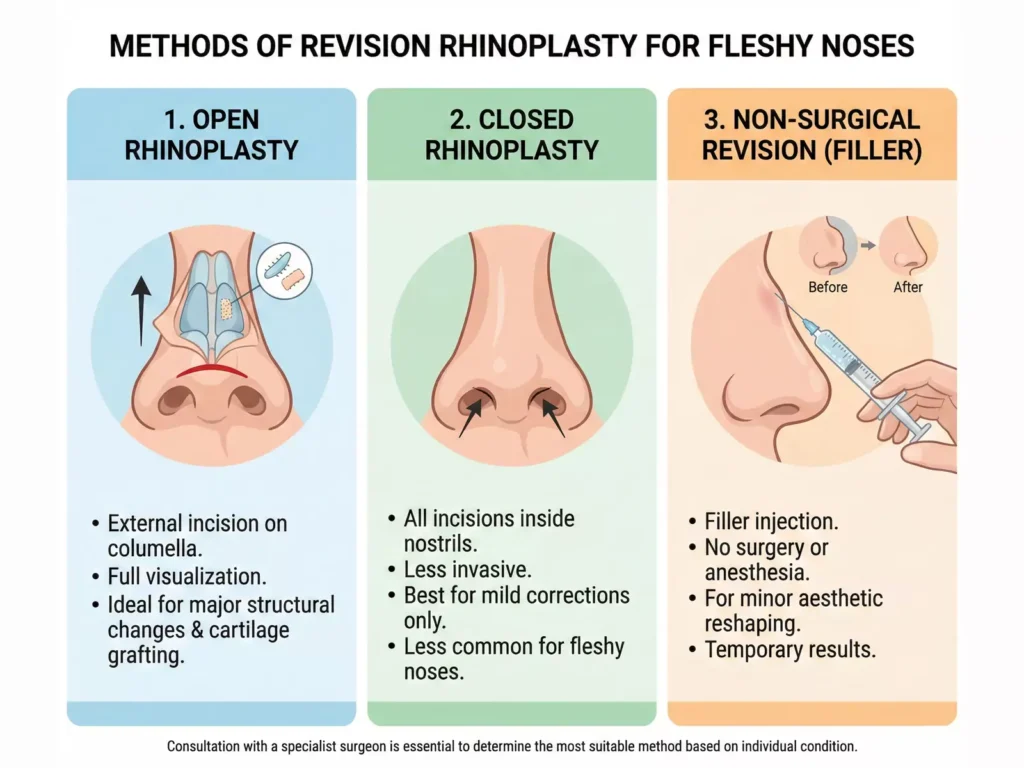
When a patient decides to undergo revision surgery, the surgeon examines the condition of the nasal tissues and selects one of the following methods based on the patient’s physical condition:
۱. Open Rhinoplasty
In the open surgery method, the surgeon makes a continuous incision across the base of the nostrils and the columella (the tissue between the nostrils) to lift the nasal skin. This provides the surgeon with full access to all nasal tissues.
This method is the best option for fleshy noses that require major structural changes, cartilage grafting, and tip refinement. After the changes are applied, the skin is returned to its place and sutured.
۲. Closed Rhinoplasty
In this method, the surgeon makes incisions inside the nostrils to apply the necessary changes. This less invasive technique is mainly used for cases requiring only mild corrections. Given the complexity of fleshy noses, this method is less commonly used than the open approach.
۳. Non-Surgical Revision (Filler Injection)
Some patients are not entirely satisfied with their primary surgery results but are afraid of undergoing another surgery and anesthesia, or their required changes are very minor. In these cases, the surgeon may use non-surgical revision methods.
Filler injection is one such method, where the surgeon reshapes parts of the nose that are aesthetically unsatisfactory by injecting dermal fillers.
Factors Affecting the Cost of Revision Rhinoplasty
The cost of fleshy nose revision depends on several factors and is usually higher than the primary surgery. These factors include:
- Extent of Damage and Complexity: The intensity and invasiveness of the revision surgery depend on the damage and defects currently observed in the nose. The greater the complexity, the more time and energy it requires from the surgeon.
- Need for Cartilage Grafting: Sometimes, to improve the nasal condition, the surgeon must use techniques like cartilage grafting (from the ear or rib). Harvesting rib cartilage is considered a separate surgery, which increases the cost.
- Surgeon’s Expertise and Skill: The doctor performing this procedure must have high expertise. The fees of skilled surgeons in the field of revision are usually higher.
- Ancillary Costs: Clinic or hospital fees, anesthesia costs, photography, and pre-operative tests are also added to the final amount.
Generally, the cost of revision surgery is higher than the primary one, and if rib cartilage is needed, this amount increases further.
Vital Post-Operative Care for Fleshy Nose Revision
After revision surgery, you must follow care instructions even more seriously than the first time. You will experience some swelling, bruising, discomfort, and pain after corrective surgery as well.
The most important care tips include:
- Cold Compress: Use a cold compress for the first 48 hours to reduce swelling and bruising around the eyes and nose more quickly. Ask your doctor for the correct way to apply it to avoid putting pressure on the nasal tissue.
- Sleeping Position: To sleep more comfortably and reduce swelling, keep your head elevated. Placing a few extra pillows behind your back and under your head (at a 45-degree angle) helps you breathe easier and prevents potential bleeding.
- Medication: Take antibiotics (to prevent infection) and pain relievers prescribed by your doctor on time and until the end of the course.
- Bathing: Do not shower for the first few days after surgery and keep the surgical site and dressing as dry as possible; this minimizes the risk of infection.
- Diet: Follow a proper, anti-inflammatory diet. Your food in the first few days should be soft and liquid. Eating solid, hard foods that require excessive chewing can negatively affect the surgical results.
- Avoid Pressure: Strictly avoid bending over or lifting heavy objects, as this increases blood pressure in the facial area.
- Activity Limitation: Cancel heavy sports and intense physical activities for several weeks after surgery; however, light walking helps improve blood circulation.
When Should You Consider Revision for a Fleshy Nose?
If you feel you have breathing problems or are dissatisfied with the appearance of your nose after rhinoplasty, revision surgery might be the right solution. However, there is a golden rule: You must wait at least one year.
Until the swelling of fleshy noses (which takes longer to subside than bony noses) has completely resolved and the tissues have softened, re-surgery carries a high risk. Operating too early can lead to skin problems and severe scarring.
Conclusion: Choosing the Best Surgeon is Key to Success
Fleshy nose revision is a second chance to correct past mistakes and achieve an ideal face. However, this surgery leaves no room for risk. The most important point regarding revision rhinoplasty is that your doctor’s skill and experience must be extensive because your nose has already been operated on once, and tissues like cartilage and bone have changed. An additional surgery means more severe invasiveness.
Dr. Armin Akbari, specializing in Otolaryngology (ENT) with extensive experience in complex reconstructive surgeries, can achieve the best result for you using precise surgical methods or non-surgical techniques (fillers).
If you are hesitant about undergoing revision rhinoplasty for your fleshy nose, contact us today for specialized consultation and analysis of your nose.
Contact Dr. Armin Akbari:
Frequently Asked Questions (FAQ)
Yes. Usually, due to the re-manipulation of tissues and disruption of the lymphatic drainage system, swelling in revision surgery is more severe, and it may take 1 to 1.5 years to fully subside.
No. The main limitation of fleshy noses is the thickness of the skin. If the nasal skeleton is made too small, the thick skin will not shrink, causing the nose to become deformed. The goal of revision is to create harmony, not excessive reduction.
If your nasal problems involve minor depressions or surface irregularities, they can be corrected with filler injections (without surgery); however, for structural and respiratory problems, revision surgery is mandatory.